
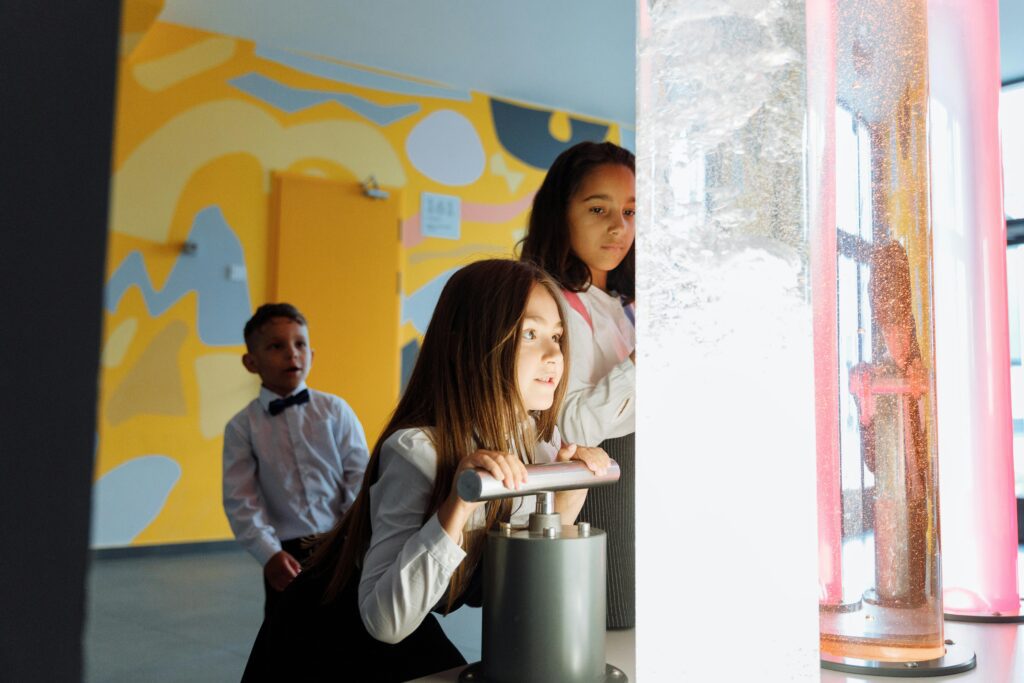
Something changes in Durack in May.
You feel it first thing in the morning — stepping outside into air that is suddenly, genuinely cool. The humidity that sat on Brisbane like a warm, damp blanket all through summer has lifted. The sky is clearer, bluer, more precise. The morning light comes in low and golden at a new angle. The grass is wet with dew. And when you breathe out, sometimes — just sometimes, on the very coolest mornings — there is a tiny cloud of mist.
To an adult, this is just the seasons changing.
To a child at Little Big People Early Learning, it is the beginning of a science investigation.
Brisbane’s autumn and winter are not dramatic in the way of southern Australia — temperatures don’t plunge, snow doesn’t fall, rivers don’t freeze. But they are real and they are rich with observable, measurable, fascinating phenomena that young scientists are perfectly placed to investigate. In May, average daytime temperatures in our part of south-west Brisbane hover around 24°C, dropping to cool overnight lows of around 15°C. By July, mornings can reach a genuinely brisk 9–10°C — cool enough to make children’s eyes go wide with curiosity.
At Little Big People Durack, we turn that curiosity into science.
Why Cool Weather Is the Best Science Weather
Here is a truth about science that every early childhood educator knows: the best experiments are the ones that happen to you, not the ones you read about.
When a child walks outside on a cool Durack morning and sees their breath make a tiny cloud in the air, they are not reading about water vapour — they are experiencing it. When they find dew on the grass and wonder where it came from, they are not studying condensation — they are discovering it. When they hold a piece of metal and a piece of wood in the same cool air and notice they feel different temperatures, they are not learning about thermal conductivity — they are feeling it.
Cool weather is a science laboratory that delivers itself to your doorstep, every morning, for free.
The Queensland Department of Education recognises that outdoor spaces are critical learning environments where children develop curiosity, resilience, and a genuine relationship with the natural world. Cool weather expands that laboratory. It adds new variables — temperature, condensation, dew, low sun angles, shadow lengths, the behaviour of materials in the cold — that were simply not available during Brisbane’s hot, humid summer.
This is why our Cool Weather Science program at Little Big People runs from May through August, matching Brisbane’s cooler season to its fullest scientific potential.
The Science of Cool: What Brisbane’s Autumn and Winter Offer Young Researchers
Before we share the experiments, let’s look at what the cool weather of Durack and south-west Brisbane actually gives us to work with:
Temperature change. Brisbane’s autumn sees temperatures drop gradually from the summer highs, settling into May’s pleasant 15–24°C range. This gradual change is observable, measurable, and graphable — even by four-year-olds.
Morning dew. As overnight temperatures drop, water vapour in the warm Brisbane air condenses on cooler surfaces — grass, outdoor furniture, leaves, and windows. Children who arrive at our centre in the cool morning can collect, observe, and investigate this condensation firsthand.
Low sun angles. In winter, the sun tracks lower across the Brisbane sky than in summer. Shadows are longer, light enters our outdoor spaces at new angles, and children who have been observing shadows since summer can watch them change across the seasons in genuinely dramatic ways.
Thermal differences. On a cool morning, metal surfaces feel much colder than wooden or fabric ones — even if they have been in the same cool air all night. This difference, invisible in summer’s uniform heat, becomes strikingly apparent when little hands explore their environment on a cool Durack morning.
Evaporation rate changes. Water evaporates more slowly in cool weather. Puddles persist longer. Wet paint dries differently. All of these are observable, investigable, and endlessly fascinating.
Breath clouds. On Brisbane’s coolest mornings — particularly in June and July — the warm, moist air from children’s lungs meets the cool outdoor air and creates visible puffs of condensation. There are few science moments in early childhood more immediately magical than a child’s first “breath cloud.”
Our Cool Weather Science Experiments: Inside the Little Big People Laboratory
🌡️ Experiment 1: The Temperature Diary
Every morning, one of our young scientists checks our outdoor thermometer and records the temperature in our Cool Weather Science Journal. Over four weeks, we track how Brisbane’s autumn temperatures change — noticing patterns, graphing the data, and making predictions.
What does the data show? May is warmer than June. Mornings are cooler than afternoons. Clear nights make for cooler mornings than cloudy ones. These are genuine meteorological patterns, discovered and documented by children who are doing exactly what scientists do: observing, recording, and making sense of the world.
💧 Experiment 2: The Dew Hunt
On cool mornings, we send our young researchers outside with magnifying glasses and small collection containers. The brief: find the dew, collect it, measure it, and figure out where it came from.
Children discover that dew collects on some surfaces more than others — on grass but not on the path, on metal but not on wood, on leaves but not on bark. When children begin to wonder why, we are in the territory of genuine scientific inquiry.
Back inside, we create a simple demonstration: a cold glass of water placed on the table begins collecting droplets on its outside within minutes. Same process. Same science. The dew explained.
🧊 Experiment 3: Ice in Autumn
Ice is not something Brisbane children encounter in nature — but it is something our on-site chef has in abundance. And it turns out our chef’s kitchen is one of the best science laboratories in the building.
We bring ice outside into the cool morning air and ask: how long does it take to melt? Does it melt faster in the sun or the shade? On metal or on plastic? What happens when we add salt?
Children make predictions. They test them. They compare results. They adjust their theories. This is the scientific method — not as a formal procedure, but as the natural rhythm of curious play.
The connection to our chef goes further: what happens when water goes into the freezer? What happens when it comes out? Kitchen science becomes classroom science, making the familiar extraordinary.
🌬️ Experiment 4: The Breath Cloud
On Brisbane’s coolest mornings — the kind of June and July mornings when you genuinely want a jacket — we take our young scientists outside for the most immediately magical experiment in our program.
Can you make a cloud with your breath?
On cool enough mornings, yes. The warm, moist air from children’s lungs meets the cool outdoor air and water vapour condenses into visible mist — a tiny, self-made cloud that lasts for a fraction of a second and produces one of the most delighted responses in early childhood science.
We explain it simply: “Your breath is warm and wet. The outside air is cool. When your warm breath hits the cool air, the water turns into tiny drops — and you can see them for a second.”
Then we try blowing warm breath onto a cool mirror and watch it fog. Same science. Different form. Just as wonderful.
☀️ Experiment 5: The Shadow Survey
In summer, the Brisbane sun sits almost directly overhead at midday, making shadows short and stubby. In winter, the sun sits lower in the sky, making shadows long and dramatic — sometimes stretching three or four times a person’s height across the playground.
Our Shadow Survey runs across the whole cool season. Children trace each other’s shadows on the pavement at 9am, 12pm, and 3pm — and compare those tracings week by week. By July, the change is unmistakable: the shadow of a child in May is noticeably different from the same shadow in July, traced on the same spot.
This is astronomy. This is geometry. This is the science of Earth’s tilt and orbit, made completely concrete by a child’s own shadow on the playground.
🌡️ Experiment 6: The Thermal Investigation Tray
On a cool morning, we set up a tray of different materials left outside overnight — a piece of metal, a wooden block, a plastic container, a piece of fabric, a smooth stone, a piece of bark.
Children touch each one in turn and record which feels coldest and which feels warmest. This is striking, because all objects have been in the same cool air for the same amount of time — yet the metal feels dramatically colder than the fabric.
Why? Metal conducts heat away from your hand much faster than fabric does. The metal doesn’t contain more cold — it moves warmth away from you more quickly.
A concept in physics. Discovered by touching. By a three-year-old on a cool Durack morning.
Cool Weather Science at Home: Brisbane Family Experiments This Season
The science laboratory is not just at our centre. Here are some simple experiments to try at home in Durack and south-west Brisbane:
- The puddle experiment — Find a puddle on a cool morning. Trace its outline with chalk. Check it every hour. How long does it take to evaporate? Compare to a summer day.
- The morning window — On a cool night, leave a glass of water by the window. In the morning, look for condensation on the outside of the glass. Where did the water come from? The Queensland Government encourages families to support children’s scientific curiosity through everyday observation — and a foggy glass is all you need.
- Hot and cold hands — Fill one bowl with warm water, one with cool. Put a hand in each for thirty seconds. Then put both hands in a bowl of room-temperature water. Does it feel warm or cool? Both at once? This experiment reveals something astonishing: temperature is relative, not absolute.
- The ice cube race — Put ice cubes on different surfaces: a metal baking tray, a wooden chopping board, a ceramic plate. Which melts fastest? Why? This is the same experiment we run at Little Big People, and it produces the same surprised, delighted faces at home.
- Make a rain gauge — Brisbane’s cool season brings less rain than summer, but it still rains. A clean jar with measurement marks is all you need to track rainfall in your backyard. Measure it after rain, compare it week to week, and talk about where the water goes.
The Chef, the Cold, and the Kitchen Connection
At Little Big People, our on-site chef is one of our most powerful science partners.
Every day, the kitchen is a working laboratory of temperature science: water boiling, ice forming in the freezer, steam rising from pots, bread rising in warmth, vegetables changing colour when heated. Our chef creates regular “science moments” for our children, connecting the kitchen’s everyday temperature transformations to the experiments happening in our outdoor spaces.
When a child who has been investigating ice-melt outside watches our chef use ice in a cooking process — when a child who has been measuring morning temperatures connects it to the oven settings in a demonstration — that cross-contextual thinking is exactly the kind of transferable learning that play-based science produces.
Science in the kitchen. Science on the playground. Science in the cool morning air. All connected. All real. All the work of curious, capable, Little Big People.
Cool Weather Science and the EYLF
Every experiment in our program is grounded in the Early Years Learning Framework (EYLF) V2.0 and Queensland’s approved early childhood curriculum:
- Outcome 4 – Confident and involved learners: Temperature investigation is pure Outcome 4 — hypothesising, experimenting, investigating, problem-solving, and learning from what the results actually show rather than what was expected.
- Outcome 2 – Connected to their world: Understanding weather, temperature, and seasonal change builds children’s genuine connection to the specific, subtropical Brisbane environment they call home.
- Outcome 3 – Strong sense of wellbeing: Nature Play QLD confirms that time outdoors in natural environments — including in cool, clear weather — supports children’s cognitive development, resilience, and overall wellbeing. The cool morning air is not a barrier to outdoor learning. It is the point of it.
- Outcome 5 – Effective communicators: Describing what they observed, explaining what they predicted, sharing what surprised them — cool weather science gives children a rich, motivated context for scientific language and communication.
- Outcome 1 – Strong sense of identity: Children who conduct experiments, make predictions, and contribute discoveries to a shared journal develop a confident identity as learners, thinkers, and scientists — the resilient, creative problem-solvers our program is designed to grow.
Come Investigate With Us
At Little Big People Early Learning Durack, we believe the best science laboratory is the world right outside the door. And right now, as Brisbane settles into its beautiful, crisp, golden cool season, that laboratory is at its most extraordinary.
We would love your family to be part of it. Enrolments are now open.
📍 56 Durella Street, Durack QLD 4077 📞 07 2111 4187 ✉️ enrolmentsdurack@littlebigpeople.com.au 🌐 littlebigpeople.com.au 🕐 Open Monday – Friday, 6:30am – 6:00pm
Our daily fees include fresh meals prepared by our on-site chef, nappies, sun-smart hats, and sunscreen — everything your child needs to investigate, explore, and thrive.
Sources
- Queensland Department of Education – Creating Effective Outdoor Learning Spaces earlychildhood.qld.gov.au – Outdoor Learning Spaces — Queensland Government guidance on outdoor environments in early childhood education, including seasonal and weather-based learning.
- Nature Play QLD – About Nature Play natureplayqld.org.au – About Nature Play — Queensland Government-supported research on the developmental benefits of outdoor play, including seasonal change and weather exploration for cognitive and physical development.
- Nature Play QLD – Nature Play in Early Years Education natureplayqld.org.au – Nature Play in Early Years Education — Research-based guidance on embedding outdoor science inquiry and child-led investigation into Queensland early childhood programs.
- Early Childhood Australia (The Spoke) – Young Children Are Little Engineers (And Why That Matters) earlychildhoodaustralia.org.au – Young Children Are Little Engineers — Early Childhood Australia’s research on children’s natural science behaviours, including hypothesising, investigating, and evaluating — central to weather and temperature science in early childhood.
- Queensland Government – Early Childhood Education qld.gov.au – Early Childhood — Queensland Government information on the EYLF V2.0, Queensland Kindergarten Learning Guidelines, and the role of science inquiry and play-based STEM in early childhood education.
- Queensland Government – Resources for Parents and Families qld.gov.au – Resources for Parents — Queensland Government guidance for families on supporting children’s scientific curiosity through everyday observation and home-based exploration.
- Early Childhood Australia – Queensland Committee earlychildhoodaustralia.org.au – Queensland Branch — Queensland’s peak advocacy body for early childhood education, providing research and resources on science inquiry, STEM, and outdoor education.
- Sunshine Coast Gallery (Sunshine Coast Council, QLD) – The Impact of Art on Children’s Development gallery.sunshinecoast.qld.gov.au – The Impact of Art on Children’s Development — A Queensland cultural institution on how open-ended investigative experiences, including science and weather experiments, support cognitive, sensory, and creative development in young children.
Little Big People Early Learning is a trusted, play-based early learning centre in Durack, south-west Brisbane, welcoming children from 15 months to school age with a QLD Government Approved Kindy program and OSHC. Open Monday to Friday, 6:30am to 6:00pm. We acknowledge the Turrbal and Yuggera/Jagera peoples as the Traditional Custodians of the Country on which our centre stands